KOICA K-HaMi Loan Program: Complete Report of the Online Information Session for Korea Returnees (21 September 2026)
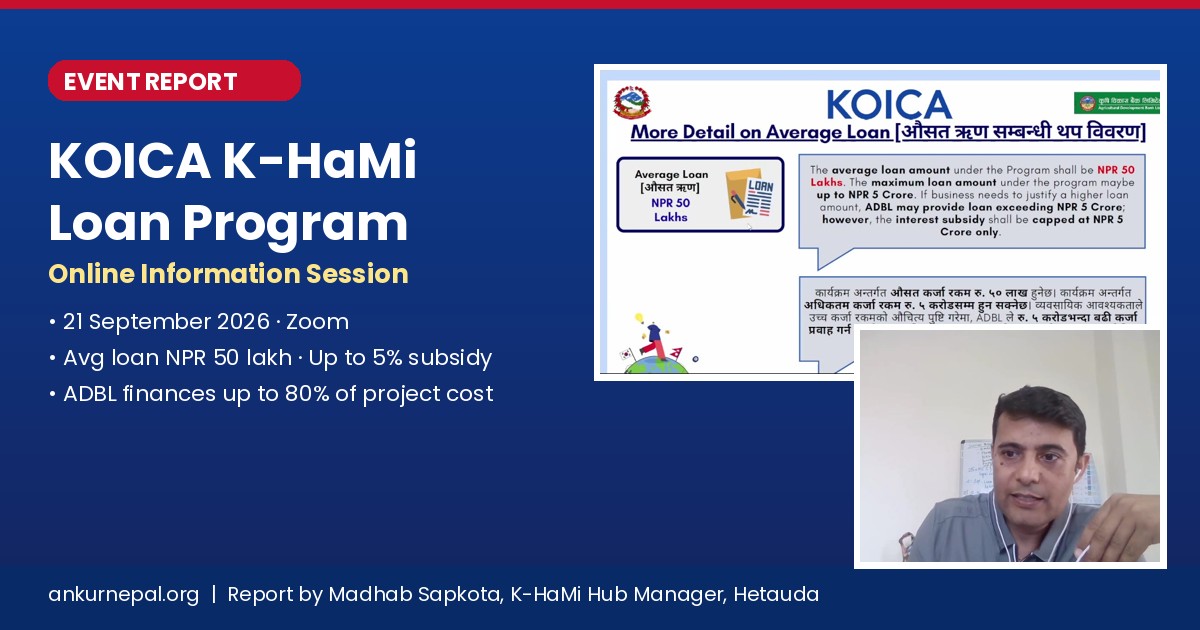
By Madhab Sapkota, K-HaMi Hub Manager (Hetauda, Bagmati Province) & General Secretary, Ankur Nepal Hetauda | Published by Ankur Nepal Hetauda | Event date: Monday, 21 September 2026 (5 Ashwin 2083)
KOICA K-HaMi Loan Program – online information session for Korea returnees, organised with Ankur Nepal Hetauda.
For thousands of Nepali workers who spent years in South Korea under the Employment Permit System (EPS), the hardest part of the journey often starts after they come home. Savings run out, business ideas stay on paper, and finding capital is difficult. The KOICA K-HaMi Loan Program was set up to address exactly this problem.On Monday, 21 September 2026, an online information session on the K-HaMi Loan Program was held over Zoom for Korea returnees across Nepal, and Ankur Nepal Hetauda helped spread the word to returnees. This report explains what happened in the program, why it was organised, what was presented, the key loan rules, and what returnees should do next. It is written for returnees who could not attend and for anyone planning to apply for a K-HaMi loan through the Agricultural Development Bank Limited (ADBL).
Quick summary
- Program: K-HaMi Loan Program online information session (जानकारीमूलक अनलाइन कार्यक्रम)
- Date & time: Monday, 21 September 2026, from 2:00 PM Nepal time, on Zoom
- Participants: more than 40 Korea returnees, hub managers and project partners
- Main message: eligibility has been expanded, the average loan is NPR 50 lakh, ADBL can finance up to 80% of project cost, and eligible borrowers may receive up to a 5% interest subsidy for up to 5 years.
What Is the KOICA K-HaMi Project?
K-HaMi stands for Korea Happy Migration. Its full name is the "Project for Strengthening Stage-Wise Support System for Stable Reintegration of Korea Returnee Migrants in Nepal." It is funded by the Korea International Cooperation Agency (KOICA) and carried out in cooperation with the Government of Korea (Ministry of Foreign Affairs) and the Government of Nepal (Ministry of Labour, Employment and Social Security).The project supports returnees at every stage, from preparing in Korea to starting and growing a business in Nepal. Its main partners are:
| Partner | Role in K-HaMi |
|---|---|
| KOICA | Funding and overall project leadership |
| Agricultural Development Bank Limited (ADBL) | Loan assessment, approval and disbursement |
| The Bridge International (TBI) | Project contractor; runs the RIN program and issues loan recommendation letters |
| MYSC (Merry Year Social Company), Korea | Monitoring and evaluation after loan disbursement |
| HRD Korea (HRDK) | Entrepreneurship and vocational training for EPS workers |
| KFCC Korea / MG Community Credit Cooperatives | Cooperation partner |
The best-known part of the project is Returnee Innovators for Nepal (RIN), a five-stage entrepreneurship program. It starts with training in Korea and continues with a bootcamp, three months of incubation and a Demo Day in Nepal. According to the official K-HaMi Nepal website, more than 200 returnees have joined and more than 30 businesses have been incubated so far.
Purpose of the Online Information Session
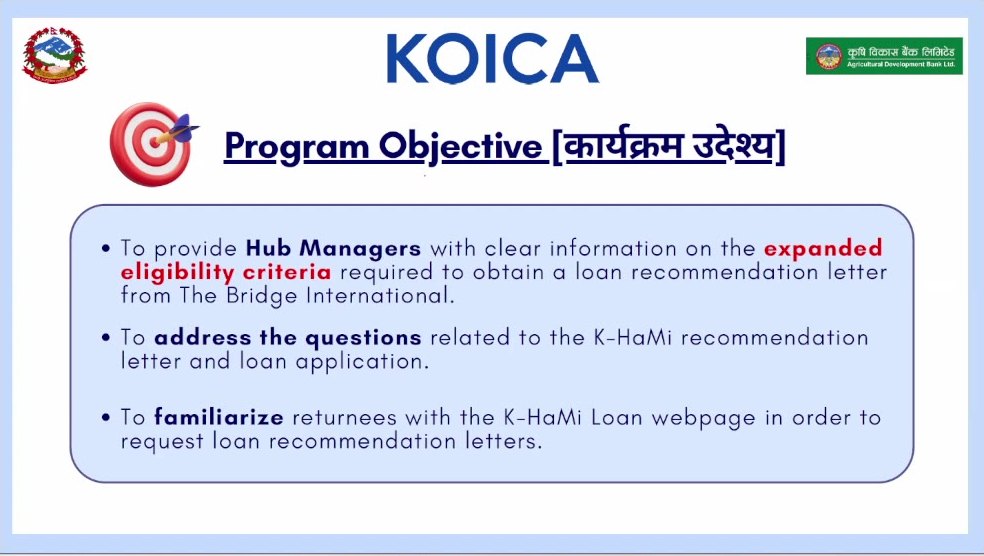
The Ankur Nepal Hetauda public notice invited all Korea returnees to learn about the loan facility, the eligibility criteria, the application process and related topics. On the day, the opening presentation set out three objectives:
- To give Hub Managers clear information on the expanded eligibility criteria for obtaining a loan recommendation letter from The Bridge International.
- To answer questions about the K-HaMi recommendation letter and the loan application.
- To familiarise returnees with the K-HaMi Loan webpage so that they can request recommendation letters on their own.
The notice also said the session would cover the introduction and aims of the program, the recently expanded eligibility criteria, the Korea returnees who took part in the PMC Reintegration Training and are now eligible, how to apply, and how to get a recommendation letter. A Q&A session was also scheduled.
What Happened in the Program: Session Report
1. Opening and participation
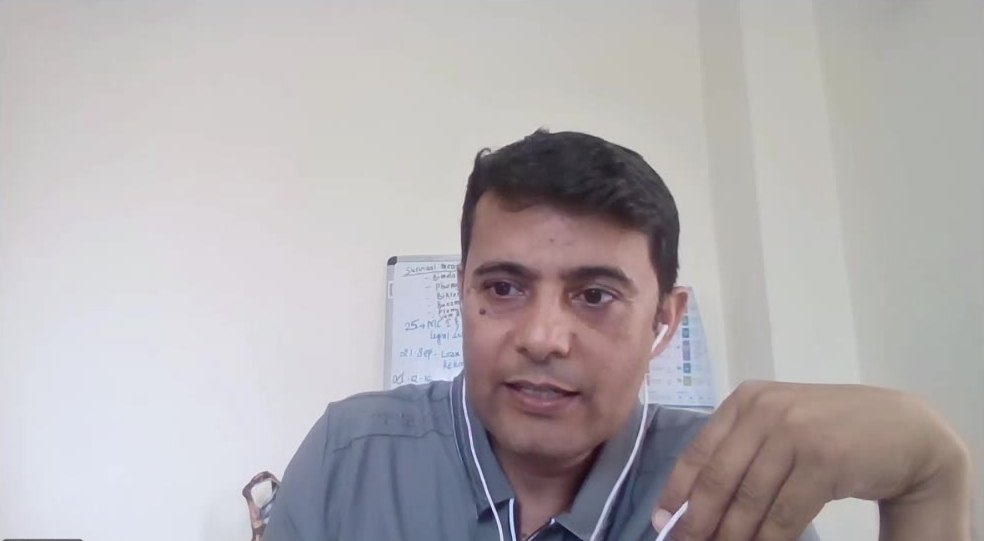
The Zoom session began shortly after 2:00 PM Nepal time and was recorded. As it progressed, more than 40 participants joined. They included Korea returnees, K-HaMi hub managers from different districts (including Hetauda, Baglung and Bhairahawa), and representatives of the implementing partners, including The Bridge International and MYSC. Returnees from many parts of Nepal were able to take part without travelling, which was an important part of the online format.
2. Presentation on program objectives and loan details
A shared slide presentation, carrying KOICA, Government of Nepal and ADBL branding, took participants through the program objectives, loan details, eligibility, the application steps and frequently asked questions. The following sections of this report summarise each part.
3. Walk-through of the K-HaMi loan webpage
Participants were shown how to use the K-HaMi Loan Support page. The walk-through covered where to check eligibility, how to download the checklist and brochure, and where to find the recommendation-letter request form.
4. Q&A session with The Bridge International
The session ended with an open Q&A session led by Himalaya Subedi of The Bridge International. Many participants raised their hands to ask about their own situations, including collateral, loan duration, eligibility for non-EPS returnees, joint-venture ownership and the EPS Career Certificate. The main questions are summarised later in this report. Because so many people had questions, the session ran well past its planned one hour. That level of interest shows how much returnees want access to business finance.
K-HaMi Loan Details at a Glance
| Feature | Details |
|---|---|
| Lender | Agricultural Development Bank Limited (ADBL) |
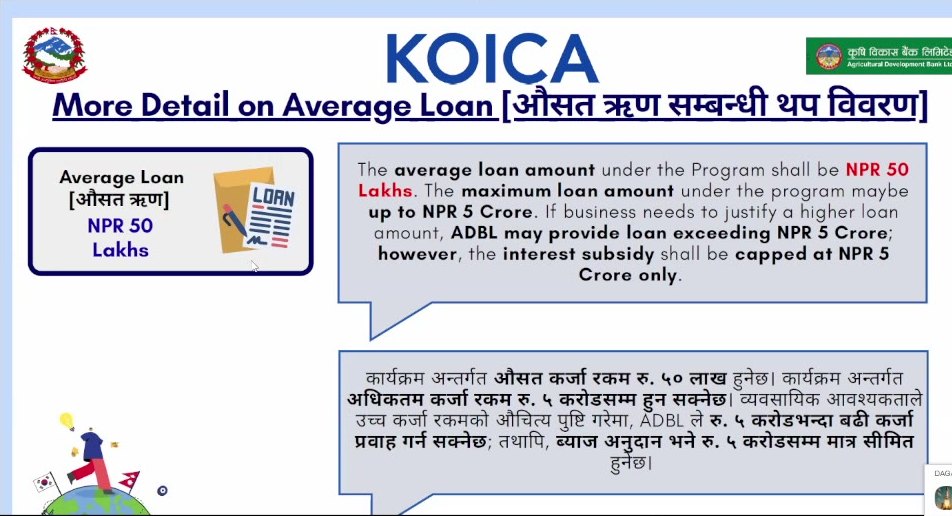
| Average loan size | NPR 50 lakh |
| Maximum loan | Up to NPR 5 crore. If business needs justify it, ADBL may lend more than NPR 5 crore, but the interest subsidy is capped at NPR 5 crore. |
| ADBL financing | Up to 80% of total project cost |
| Self-contribution | Minimum 20% of total project cost |
| Interest subsidy | Up to 5% for up to 5 years (depending on the nature of the project) |
| Collateral | Required (for example, land or a house) |
| Recommendation letter validity | Valid for one year from the date of issue, non-transferable, and valid only at ADBL |
Important: A recommendation letter from The Bridge International does not guarantee loan approval. ADBL makes all loan assessments and decisions under its own policies and procedures.
Who Can Apply? Expanded Eligibility Criteria
The session focused on the expanded eligibility criteria. According to the K-HaMi loan page, you must meet all of the following conditions:
- Citizenship: Nepali citizen with no criminal record.
- EPS history: valid proof of work in Korea under the Employment Permit System.
- Business: a government-registered business (non-military purpose) in the applicant's name, including single-household family businesses.
- Ownership: at least 51% of the shares and active involvement in management.
- Training: completion of either the Returnee Innovators for Nepal (RIN) training by The Bridge International or the HRD Korea Entrepreneurship & Vocational Training program. The session slides also list the Reintegration Information Training certificate as acceptable, and the Ankur Nepal notice said that returnees who attended the PMC Reintegration Training are now eligible.
Extra conditions from the ADBL loan brochure
The step-by-step guide in the K-HaMi loan brochure adds some practical checks that ADBL will look at:
- Collateral you can pledge, such as land or a house.
- A business registered as a sole proprietorship, private company or partnership. If it is not registered, contact your local authority first.
- Financial records such as account books and income and expense records.
- A tax clearance certificate or a document proving tax exemption.
- Information about the business location, such as photos, a map or a layout.
- A clean credit history. If you have negative records, the application will not be accepted, so visit your nearest ADBL branch to review your credit history first.
Required Documents Checklist
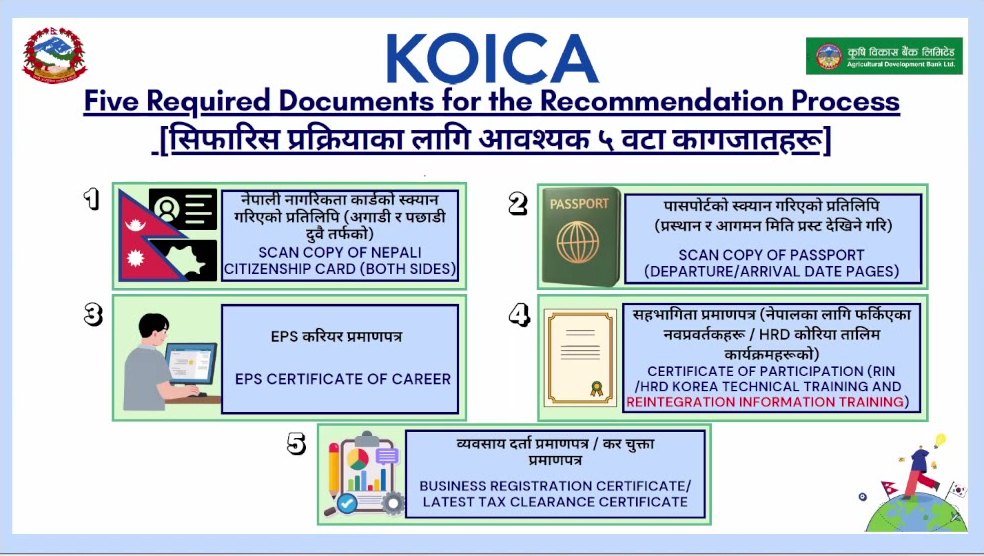
The official checklist, headed "आवश्यक कागजातहरू जाँच सूची", lists five documents, all of which are required:
| # | Document | Tip |
|---|---|---|
| 1 | Scanned copy of Nepali citizenship certificate (both sides) | Make sure the scan is clear and readable |
| 2 | Scanned copy of passport (pages with departure and arrival dates) | Include the bio-data page and the stamp pages |
| 3 | EPS Certificate of Career | Download it from eps.go.kr using your EPS ID |
| 4 | Certificate of Participation (RIN / HRD Korea training programs) | Ask the K-HaMi project team if you do not have it |
| 5 | Latest Business Registration Certificate / Tax Clearance Certificate | Must be issued by the Government of Nepal |
Accepted formats: PDF, JPG, JPEG, PNG or Word (.doc/.docx). Use simple English file names, as missing or unclear documents may lead to rejection. The official site also has a video tutorial on downloading the EPS Certificate of Career.
How to Apply for the K-HaMi Loan: Step by Step
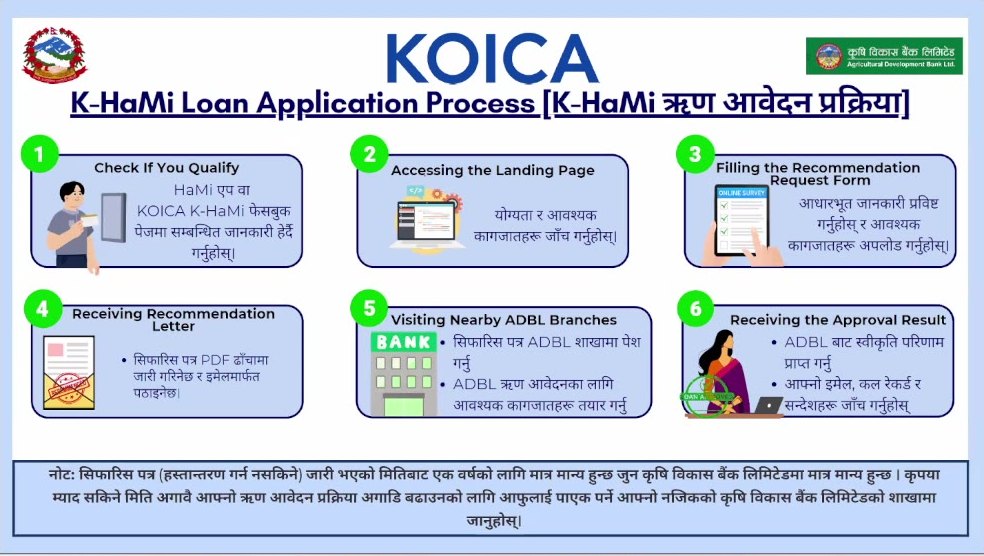
The presenters explained that the process has two stages. First you get a recommendation letter from The Bridge International, and then you apply for the loan at ADBL.
Stage A: Get your recommendation letter
- Check if you qualify. Review the eligibility criteria and required documents on the K-HaMi App or the KOICA K-HaMi Facebook page.
- Open the landing page. Go to khaminepal.org/loan and check the eligibility and document requirements.
- Fill in the recommendation request form. Enter your basic details and upload all five documents through the official Google Form.
- Receive your recommendation letter. After The Bridge International reviews your application, the letter is emailed to you as a PDF. If anything is missing, they will contact you by phone or email.
Stage B: Apply at ADBL
- Visit your nearest ADBL branch. Submit the recommendation letter and prepare the documents ADBL asks for.
- Receive the approval result. ADBL assesses the loan and makes the decision, so keep checking your email, calls and messages.
- Loan disbursement, then monitoring and evaluation. After disbursement, MYSC from Korea may contact you for surveys, short interviews and business site visits. These are carried out to keep the program transparent and to improve how well it works.
Do not miss the deadline: The recommendation letter is valid for one year from the date of issue. Start your ADBL loan application well before it expires.
Frequently Asked Questions Raised in the Session
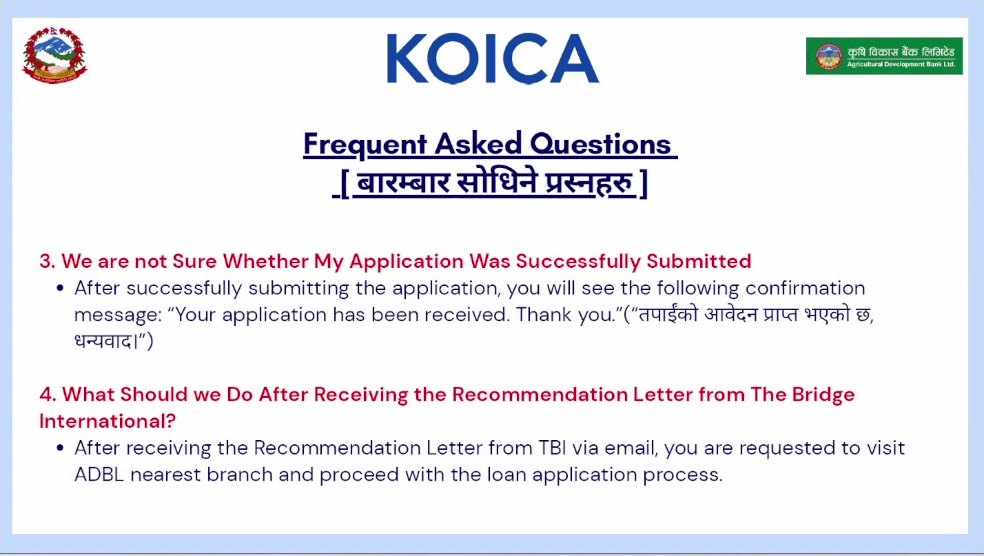
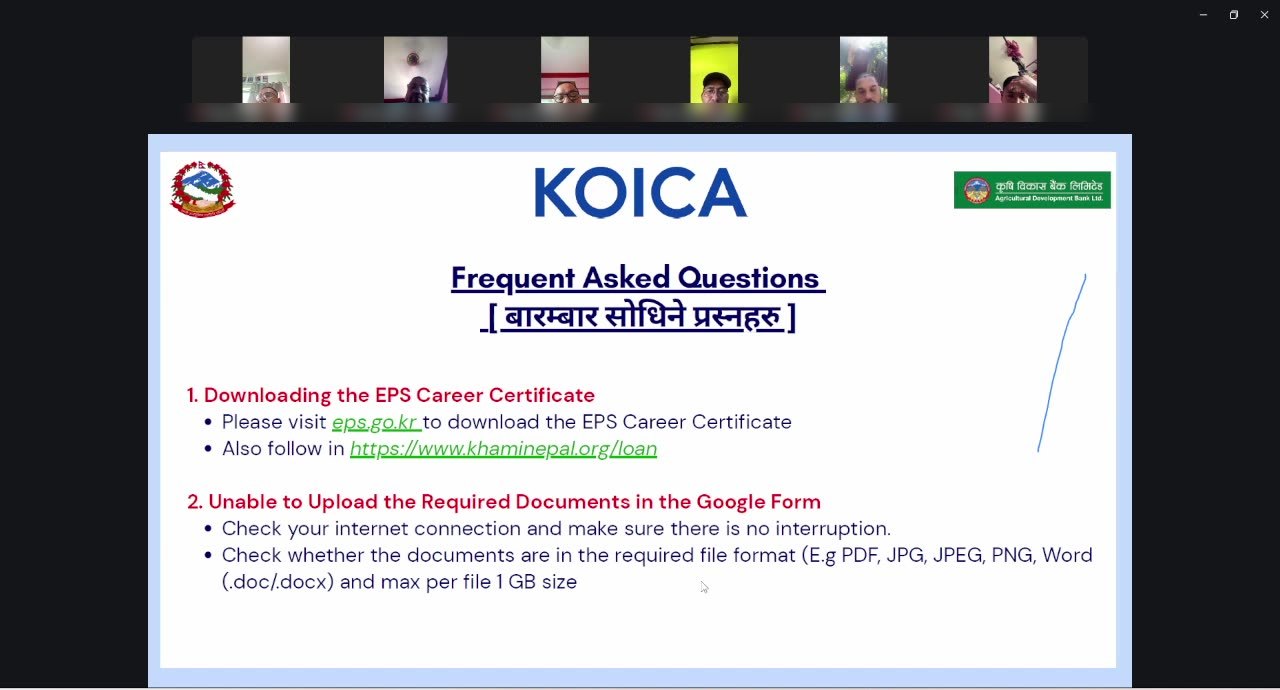
How do I download the EPS Career Certificate?
Visit eps.go.kr and follow the guide on the K-HaMi loan page. If you need help with your EPS ID or other EPS paperwork, returnees in Makwanpur can also get support locally through the EPS-TOPIK auxiliary services in Hetauda.
I cannot upload my documents to the Google Form. What should I do?
Check that your internet connection is stable, and make sure each file is in an accepted format (PDF, JPG, JPEG, PNG, Word) and no larger than 1 GB.
Does a recommendation letter guarantee the loan?
No. ADBL makes the final decision after its own screening.
Where do I apply for the loan itself?
At your nearest Agricultural Development Bank Limited (ADBL) branch.
Key Questions Asked in the Q&A Session
The Bridge International recorded participants' questions in the Zoom chat during the Q&A. Among the questions raised by returnees, hub managers and representatives of Sanghi Nepal (a Korea returnee women's organisation) were:
| Question raised | What returnees should know |
|---|---|
| Is the loan only for EPS returnees, or for other returnees too? | Under the current criteria, valid proof of EPS work in Korea is required. Sanghi Nepal suggested that returnees who did not go through EPS should also be included in future. |
| How long can the loan run? | It was confirmed in the session that the loan can be taken for 10–15 years, but the interest subsidy applies for 5 years only. |
| Can I get this business loan if I already have a personal loan? | ADBL assesses each application, including your existing borrowing and credit history. A clean credit record is required. |
| Is there any separation by loan type or sector? | The loan supports registered businesses in different sectors. Talk to your ADBL branch about the product that fits your business. |
| What exactly is required as collateral? Can it belong to other family members? | Collateral such as land or a house is required. Whether family-owned property can be used is decided by ADBL under its policies, so ask your branch before applying. |
| Are there limits on the amount and on who can borrow? | The average loan is NPR 50 lakh and the maximum is NPR 5 crore, and you must meet all the eligibility criteria. |
| Must the business already be registered? | Yes. It must be a government-registered business in the applicant's name. |
| Many returnee businesses are 50-50 joint ventures with non-returnees. How can we reach 51%? | The applicant must hold at least 51% of the shares and be actively involved in management. Restructure the ownership formally at the relevant registration office before applying. |
| How do I get my EPS Career Certificate? | Download it from eps.go.kr using your EPS ID. The K-HaMi loan page links to a video tutorial. |
| Are other technical or skill-based trainings available? | Check the RIN program and the HRD Korea programs on the K-HaMi website, and follow the KOICA K-HaMi Facebook page for new training calls. |
The right-hand column combines what was confirmed in the session with the official program rules. For your own case, confirm with ADBL or The Bridge International.
ADBL Services for Korea Returnees
The program materials also introduced ADBL services that returnees can combine with the K-HaMi loan:
- SME loan (साना तथा मझौला व्यवसाय कर्जा): flexible repayment periods and support for growing a business.
- Agricultural mechanisation loan: loans at concessional interest rates for buying modern farm equipment.
- Agricultural production loan: support for seeds, fertiliser, irrigation and production costs.
- Korea–Nepal remittance through KEB Hana Bank: deposit at any KEB Hana Bank branch in Korea and receive the money directly in your ADBL account in Nepal. Special benefits advertised for Korean returnees include an extra 1% interest rate, an easier loan approval process and convenient banking.
- ADBL Mobile Banking: 24-hour fund transfers, bill payments and balance checks.
For loan products and conditions, contact the ADBL Agriculture Credit & Project Management Department at agriloan.div@adbl.gov.np or call 01-4263387. For the recommendation letter, contact The Bridge International Nepal at tbinepal@thebridgeint.com.
Why This Matters for Korea Returnees in Hetauda and Bagmati Province
Makwanpur and the wider Bagmati Province have a large community of workers who went to Korea through EPS. Ankur Nepal was founded in 2012 at the initiative of the Korean Embassy to protect the rights of Korea returnees and encourage them to start businesses. Its Hetauda contact committee connects returnees with KOICA, the EPS office, HRD Korea and government bodies.For local returnees, the K-HaMi Loan Program is one of the most practical financing options available today. The average loan of NPR 50 lakh, a possible 5% interest subsidy and ADBL's large branch network are well suited to agriculture, food processing, retail and service businesses. As the Hetauda hub, we encourage every eligible returnee to prepare their documents now rather than waiting.For young people who hope to go to Korea, K-HaMi also shows why preparation matters. The EPS work history that leads to K-HaMi eligibility begins with passing the EPS-TOPIK exam. Structured EPS-TOPIK Korean language classes in Hetauda help with that, and so do trusted EPS preparation institutes.
नेपालीमा सारांश
२१ सेप्टेम्बर २०२६ (५ असोज २०८३) मा KOICA K-HaMi Loan Program सम्बन्धी जानकारीमूलक अनलाइन कार्यक्रम Zoom मार्फत सम्पन्न भयो। कार्यक्रममा ऋणको योग्यता तथा मापदण्ड, आवश्यक कागजात, सिफारिस पत्र प्राप्त गर्ने प्रक्रिया र ADBL मा ऋण आवेदन दिने तरिकाबारे जानकारी दिइयो। औसत ऋण रकम रु. ५० लाख हो, र कुल परियोजना लागतको ८०% सम्म ADBL ले लगानी गर्न सक्छ। योग्य लाभग्राहीले ५ वर्षसम्म ५% सम्म ब्याज अनुदान पाउन सक्छन्। सिफारिस पत्र जारी भएको मितिबाट एक वर्षसम्म मात्र मान्य हुन्छ। थप जानकारीका लागि khaminepal.org/loan हेर्नुहोस् वा अंकुर नेपाल हेटौंडा सम्पर्क समितिमा सम्पर्क गर्नुहोस्।
Conclusion
The 21 September 2026 online session did what it set out to do. Hub managers and returnees got clear information on the expanded eligibility criteria, learned how to use the K-HaMi loan webpage, and had their questions answered by The Bridge International. The key points to remember are to get a recommendation letter first, apply at ADBL within one year, and keep your business registration, tax, credit and collateral documents in order.Korea returnees bring home skills, discipline and savings earned through hard work. With the KOICA K-HaMi Loan Program, that experience can become a business that creates jobs in Nepal.Ready to apply?
- Check eligibility and download the checklist: K-HaMi Loan Support
- Join the returnee network: Ankur Nepal Hetauda
- Need help with documents, Korean language or EPS paperwork in Hetauda? Contact Toddle Multipurpose Company
About the Author
Madhab Sapkota is the KOICA K-HaMi Project Hub Manager for Hetauda, Bagmati Province, and the General Secretary of Ankur Nepal Hetauda, the contact committee of Korea returnees in Hetauda. He is also the Founder & CEO of Toddle Multipurpose Company, an education and international-opportunities organisation in Hetauda, and the Nepal Country Representative of Dagachi Inc., the Korea-based network that supports foreigners in Korea and people connected with Korea.Madhab holds an MBA, has passed TOPIK Level 6 and is a certified Korean language instructor. He works to build meaningful links between Nepal and South Korea through education, returnee reintegration and international cooperation. Read his full profile on the Toddle leadership page, or read the CEO's message.
Related reading
- EPS-TOPIK Exam Guide for Nepali Workers
- EPS-TOPIK Auxiliary Services: Form, EPS ID & Police Report
- Toddle Multipurpose Company: EPS Preparation in Hetauda
- Free Support Services: Passport, PAN, ID & Bank Help in Hetauda
- Essential Bank Guide for Going Abroad
- Basic Korean Language Class in Hetauda
- Returnee Innovators for Nepal (RIN) Program
Sources: K-HaMi Nepal – Loan Support; Ankur Nepal Hetauda program notice; the official K-HaMi documents checklist, K-HaMi loan brochure and ADBL product and remittance flyers; and the session recording and Zoom chat notes of 21 September 2026. Loan terms may change, so always confirm with ADBL and The Bridge International before applying.